

New Refugees Resettled in the U.S. in 2016
As the ongoing civil war in Syria drove steady growth in the global refugee population, the number of new refugees admitted to the United States increased significantly in calendar year 2016, according to the U.S. Department of State’s Refugee Processing Center. However, the new presidential administration’s two attempts to temporarily block refugee resettlement in the U.S. as well as a shift in sentiment toward refugees among some segments of the U.S. population have many advocates and agencies who work with refugees ringing alarm bells.[i] These actions have consequences for the refugee community. The receptiveness of host communities toward refugees is an important factor related to their reintegration into society and their ability to cope with the trauma that they have experienced, as SocialWork@Simmons Professor Hugo Kamya noted last year in a discussion on the mental health needs of new arrivals.[ii]
As lawmakers, advocates, and the general public debate how best to address refugees, it is important to first and foremost recognize who they are and where they are coming from. Political rhetoric and commentary are peppered with skewed opinions and misinformation that often feed into myths about this diverse population. Instead of developing policy based on emotion and fear, we should review 2016’s numbers to help put in context how the global refugee crisis is affecting the United States.
Although the Syrian crisis has continued to contribute the largest number of people to the global refugee population, the Democratic Republic of Congo (DRC) produced the largest number of refugees resettled in the U.S. in calendar year 2016. Syria comes in second, followed by Myanmar, Iraq, and Somalia. Of all the refugees resettled in the U.S. in 2016, 90 percent were from just 10 countries.
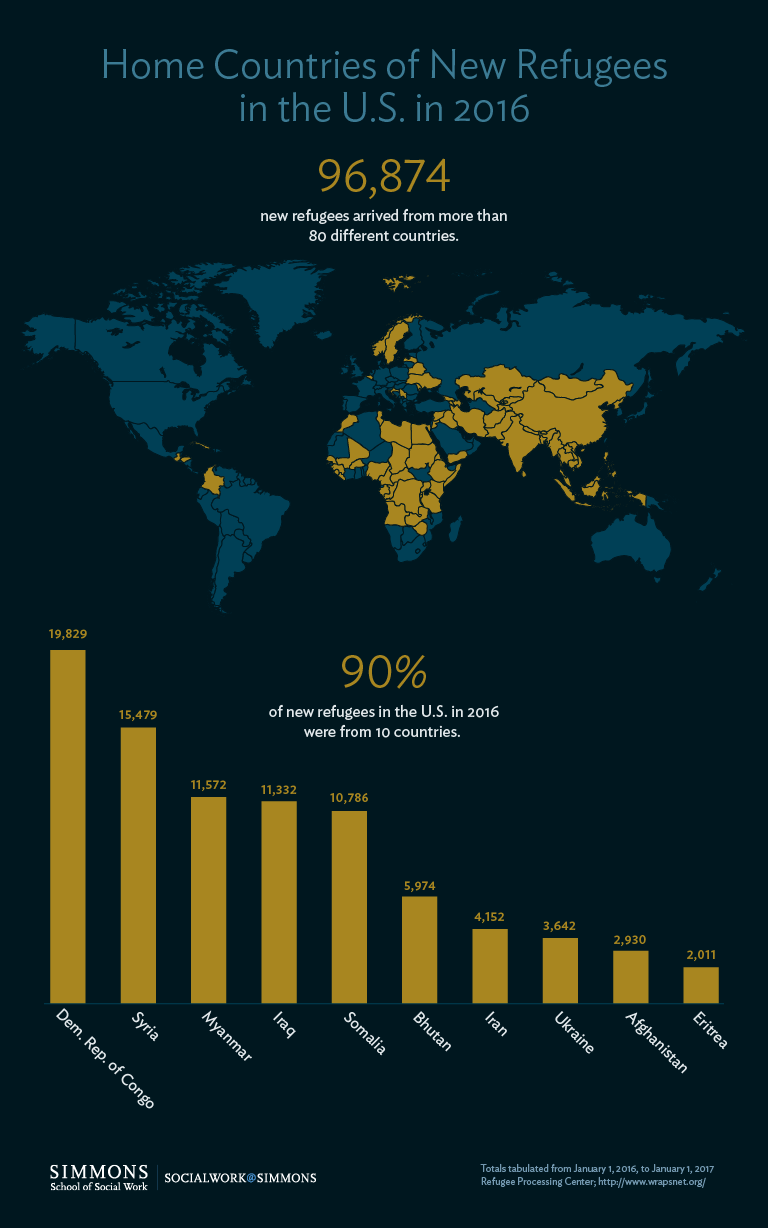
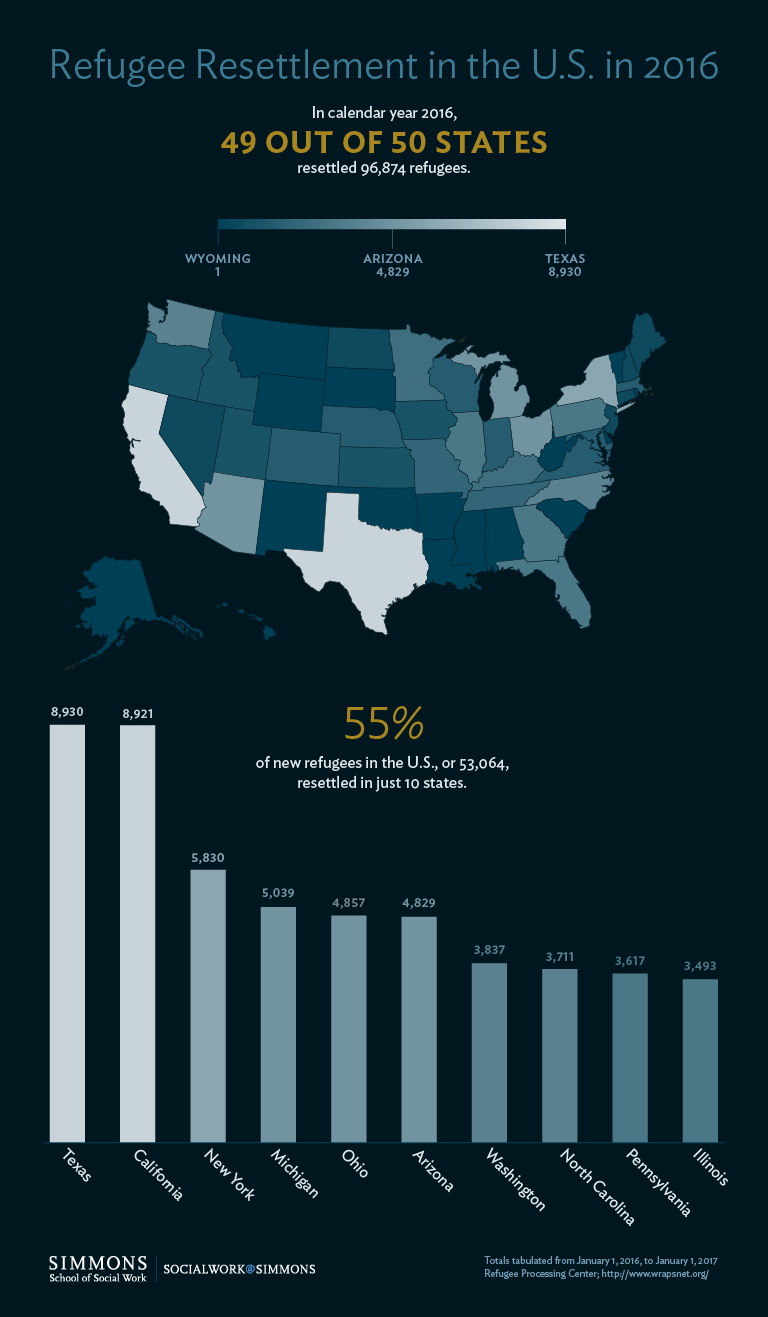
Still, new arrivals in 2016 came from a diverse spread of countries from every region in the world. Refugees arrived from 80 different countries, resettling in 49 states in the U.S. as well as the District of Columbia. Texas, California, and New York resettled the largest numbers of refugees in the U.S., respectively, while Delaware was the only state in 2016 that did not take in new refugee arrivals. More than half of all refugees resettled in the U.S. were resettled in just 10 states.
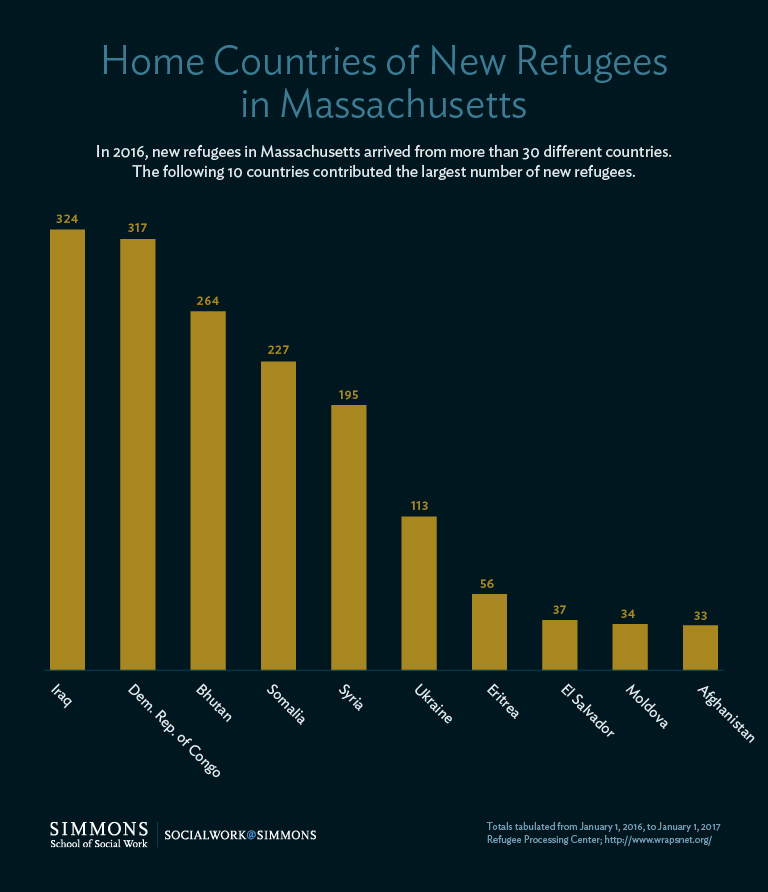
Massachusetts ranked 21st among all states and D.C. in terms of most refugees resettled in 2016. More than 1,800 refugees from more than 30 countries were resettled throughout the state. The top home countries of new refugees in Massachusetts included Iraq, Democratic Republic of Congo, and Bhutan.
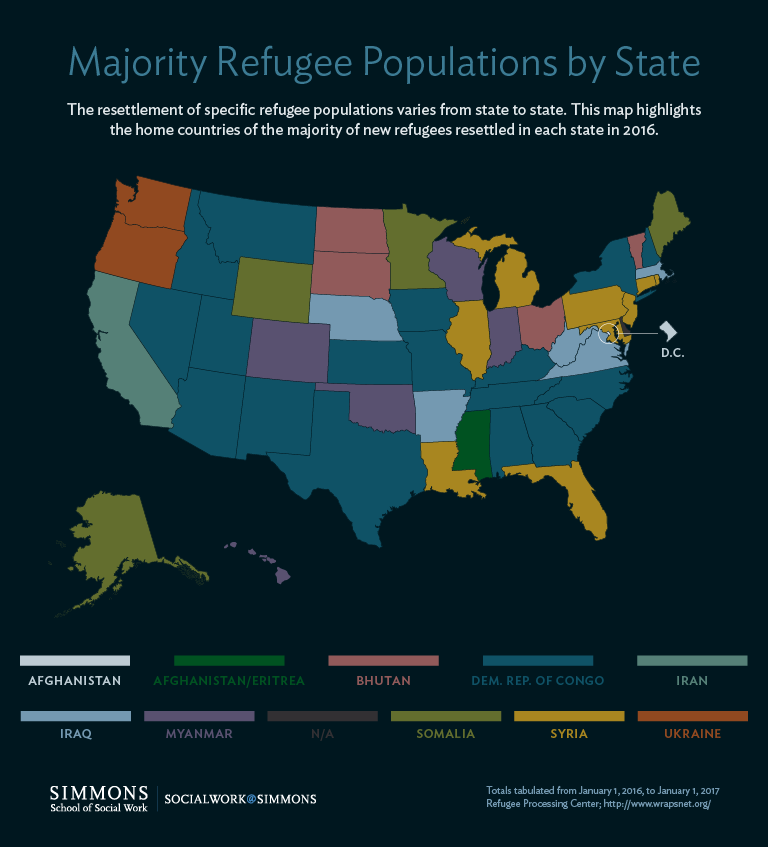
Refugees from various home countries are not spread evenly across the United States. For example, Washington and Oregon resettled a majority Ukrainian refugee population, while the majority of refugees resettled in North Dakota and South Dakota was from Bhutan.
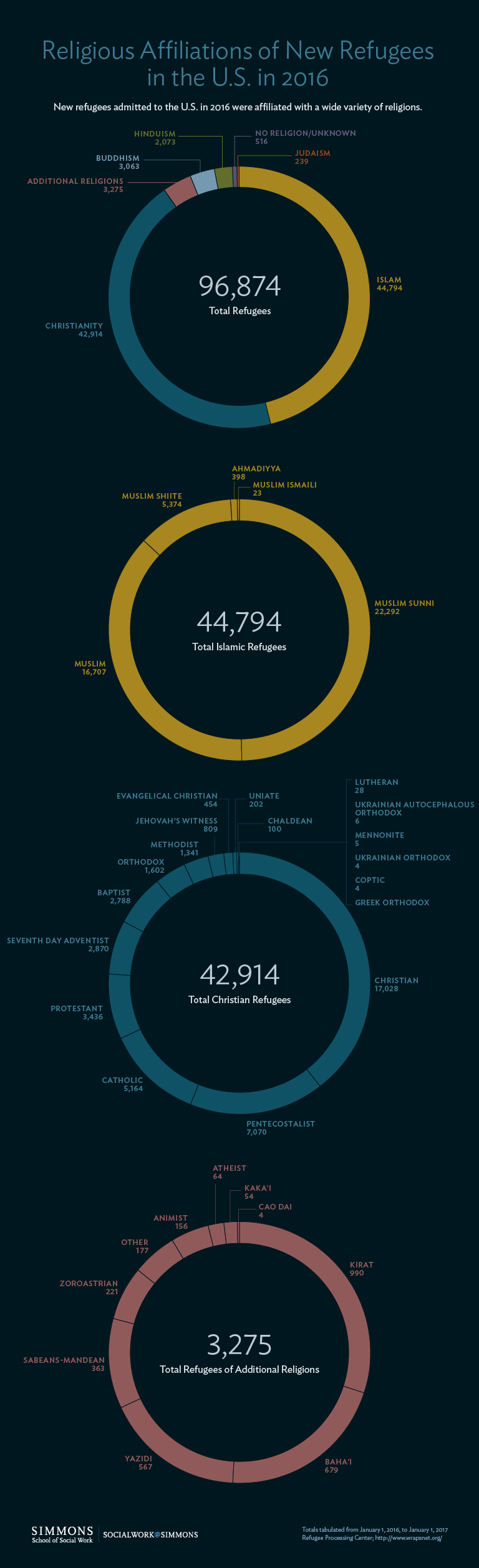
In addition to being geographically diverse, refugees in the U.S. are culturally diverse. New arrivals in 2016 affiliated with more than 30 different religious traditions. Between 2008 and 2016 the most frequent native languages of new refugees have included Arabic, Nepali, Somali, Sgaw Karen, and Spanish.[iii] However, many refugees make significant strides toward integration over time. A report from the Center for American Progress found that the majority of refugees studied who had been in the U.S. for 10 years were at least proficient in English, while the majority who had been in the U.S. more than 20 years became naturalized citizens.[iv]
Data helps to explain part of the story of refugee resettlement in 2016. But understanding the journey that many refugees have gone through is equally, if not more, important.
“People need to be informed about who these folks are and where they are coming from. These new arrivals are not simply economic migrants, but people escaping horrible situations and seeking safety,” Kamya said. “This will take a fair amount of willingness for people to put themselves in refugees’ situations, which can be difficult for many in the Western world to grasp.”[v]
Read Professor Kamya’s full commentary in our previous piece, “The Coming Tide: Addressing the Mental Health Needs of New Refugees.”
-
Home Countries of New Refugees in U.S. in 2016
96,784 new refugees arrived from more than 80 different countries. 90% of new refugees in the U.S. were from 10 countries.
Home Countries of New Refugees in U.S. in 2016
Country of Origin Total Dem Rep. of Congo19,829Syria15,479Myanmar11,572Iraq11,332Somalia10,786Bhutan5,974Iran4,152Ukraine3,642Afghanistan2,930Eritrea2,011Sudan1,479Ethiopia1,322Burundi777El Salvador757Pakistan604Central African Republic555Molodova550Russia527Colombia476Cuba351Republic of South Sudan221Belarus187Rwanda150Honduras140Sri Lanka84Kazahkstan82Palestine71Uganda71Ivory Coast65Armenia64Vietnam57China56Kyrgyzstan54Uzbekistan46Azerbaijan39Nepal33Egypt27Senegal27Yemen27Guatemala24North Korea19Liberia19Cameroon18Cambodia17Congo16Togo14Georgia11Zimbabwe11Latvia8Chad7Laos7Nigeria7Jordan6Kenya6Kuwait6Gambia5Guinea5India5Sierra Leone5Libya4Mali4Angola3Bangladesh3Malaysia3Mongolia3Thailand3Belgium2Croatia2Djibouti2Gabon2Morocco2Norway2Philippines2Serbia2Sweden2Tajikistan2Tunisia2Burkina Faso1Indonesia1Jamaica1Tanzania1Tibet1UAE1Zambia1Total96,874Although the Syrian crisis has continued to contribute the largest number of refugees to the global refugee population, the Democratic Republic of Congo (DRC) is home to the largest number of refugees resettled in the U.S. in calendar year 2016. Syria comes in second, followed by Myanmar, Iraq, and Somalia. The top 10 home countries of new arrivals in the U.S. were home to more than 90 percent of all refugees resettled in the U.S. in 2016.
Refugee Resettlement in the U.S. in 2016
In calendar year 2016, 49 out of 50 states resettled 96,874 refugees. 55% of new refugees in the U.S., or 53,064, resettled in just 10 states.
Refugee Resettlement in the U.S. in 2016
State Total Texas8,930California8,921New York5,830Michigan5,039Ohio4,857Arizona4,829Washington3,837North Carolina3,711Pennsylvania3,617Illinois3,493Georgia3,473Florida3,272Minnesota3,009Kentucky2,847Missouri2,337Tennessee2,145Indiana2,100Maryland1,952Colorado1,910Wisconsin1,877Massachusetts1,827Nebraska1,782Virginia1,678Oregon1,566Utah1,319Idaho1,232Iowa1,087Kansas1,053Nevada899Connecticut897Maine714New Hampshire619New Jersey601North Dakota560Oklahoma468South Dakota460New Mexico411Rhode Island400South Carolina399Vermont397Louisiana162Alabama120Alaska112Montana46West Virginia32Arkansas22Mississippi13District of Columbia8Hawaii3Wyoming1Delaware0Total96,874Still, new arrivals in 2016 came from a diverse spread of countries from every region in the world. Refugees arrived from 80 different countries, resettling in 49 states in the U.S. as well as the District of Columbia. Texas, California, and New York resettled the largest numbers of refugees in the U.S. respectively, while Delaware was the only state in calendar year 2016 that did not take in new refugee arrivals. In fact, more than half of all refugees resettled in the U.S. were resettled in just 10 states.
Home Countries of New Refugees in Massachusetts
In 2016, new refugees from Massachusetts arrived from more than 30 different countries. The following 10 countries contributed the largest numbers of refugees.
Home Countries of New Refugees in Massachusetts
CountryTotalIraq324Dem. Rep. of Congo317Bhutan264Somalia227Syria195Ukraine113Eritrea56El Salvador37Moldova34Afghanistan33Massachusetts ranked 21st among all states and the District of Columbia in terms of most refugees resettled in calendar year 2016. More than 1,800 refugees were resettled throughout the state from more than 30 different countries. The top home countries of new refugees in Massachusetts included Iraq, the Democratic Republic of Congo, and Bhutan.
Majority Refugee Populations by State
The resettlement of specific refugee populations varies from state to state. This list highlights the home countries of the majority of new refugees resettled in each state in 2016.
Majority Refugee Populations by State
State Country AlabamaDRCAlaskaSomaliaArizonaDRCArkansasIraqCaliforniaIranColoradoMyanmarConnecticutSyriaDelawareN/ADistrict of ColumbiaAfghanistanFloridaSyriaGeorgiaDRCHawaiiMyanmarIdahoDRCIllinoisSyriaIndianaMyanmarIowaDRCKansasDRCKentuckyDRCLouisianaSyriaMaineSomaliaMarylandSyriaMassachusettsIraqMichiganSyriaMinnesotaSomaliaMississippiAfghanistan/EritreaMissouriDRCMontanaDRCNebraskaIraqNevadaDRCNew HampshireDRCNew JerseySyriaNew MexicoDRCNew YorkDRCNorth CarolinaDRCNorth DakotaBhutanOhioBhutanOklahomaMyanmarOregonUkrainePennsylvaniaSyriaRhode IslandSyriaSouth CarolinaDRCSouth DakotaBhutanTennesseeDRCTexasDRCUtahDRCVermontBhutanVirginiaIraqWashingtonUkraineWest VirginiaIraqWisconsinMyanmarWyomingSomaliaRefugees from various home countries are not spread evenly across the United States. For example, states in the Pacific Northwest including Washington and Oregon resettled a majority Ukrainian refugee population, while the majority of refugees resettled in the North Dakota and South Dakota were from Bhutan. Overall, nine different countries contributed a majority of a refugee population in at least one state.
Religious Affiliations of New Refugees in the U.S. in 2016
New refugees admitted to the U.S. in 2016 were affiliated with a wide variety of religions.
Religious Affiliations of New Refugees in the U.S. in 2016
Religion Total Islam44,794Christianity42,914Buddhism3,063Hinduism2,073Judaism239Additional Religions3275No Religion/Unknown516Religious Affiliations of New Refugees in the U.S. in 2016
Religion Total Ahmadiyya398Animist156Atheist64Baha’i679Baptist2,788Buddhist3,063Cao Dai4Catholic5,164Chaldean100Christian17,028Coptic4Evangelical Christian454Greek Orthodox3Hindu2,073Jehovah’s Witness809Jewish239Kaka’i54Kirat990Lutheran28Mennonite5Methodist1,341Muslim16,707Muslim Ismaili23Muslim Shiite5,374Muslim Sunni22,292No Religion512Orthodox1,602Other177Pentecostalist7,070Protestant3,436Sabeans-Mandean363Seventh Day Adventist2,870Ukrainian Orthodox4Ukrainian Autocephalous Orthodox6Uniate202Unknown4Yazidi567Zoroastrian221
—
[i] Eviatar, D. “The New Travel Ban Is Still a Muslim Ban,” The Atlantic, March 7, 2017. Accessed March 31, 2017. https://www.theatlantic.com/international/archive/2017/03/trump-muslim-executive-order-syria-yemen-refugee-bannon-breitbart/518808/
[ii] “The Coming Tide: Addressing the Mental Health Needs of New Refugees,” SocialWork@Simmons, July 22, 2016. Accessed March 15, 2016. https://socialwork.simmons.edu/blog/addressing-mental-health-needs-refugees/
[iii] “Top 10 Languages Spoken by Arrived Refugees,” Refugee Processing Center, December 31, 2016. Accessed March 15, 2016. http://www.wrapsnet.org/admissions-and-arrivals/
[iv] Kallick, D. & Mathema, S. “Refugee Integration in the United States,” Center for American Progress, June 2016. Accessed March 15, 2016. https://cdn.americanprogress.org/wp-content/uploads/2016/06/15112912/refugeeintegration.pdf
[v] “The Coming Tide,” 2016.